


Financial Advisor CRM Comparison: Toolkit vs. Wealthbox vs. Redtail

Which CRM is best for financial advisors?
So, you want the best CRM for your specific practice?
The first step is to start a comparison of CRMs specifically designed for financial advisors, with the goal of answering these core questions:
- Which CRM is best for financial advisors?
- How do Toolkit CRM, Wealthbox CRM, and Redtail CRM compare?
- What are the main differences in workflows, client service, segmentation, integrations, usability, pricing, and support?
- Which CRM is the best fit for a solo advisor, small team, growing RIA, or process-driven advisory firm?
- What should an advisor consider before switching from their current CRM?
- What is support like for each CRM?
To help you determine which CRM solution best fits your needs, we've laid out the salient points in the following sections:
- Workflows and Practice Management
- Client Service and Relationship Management
- Client Segmentation
- Integration
- Usability and Team Adoption
- Pricing
- Support and Implementation
- Which CRM Is Best for a Solo Advisor, Small Team or Growing RIA?
- What Should You Consider Before Switching From Your Current CRM?
- Toolkit CRM vs. Wealthbox CRM vs. Redtail CRM: The Bottom Line
Let's get right into it!
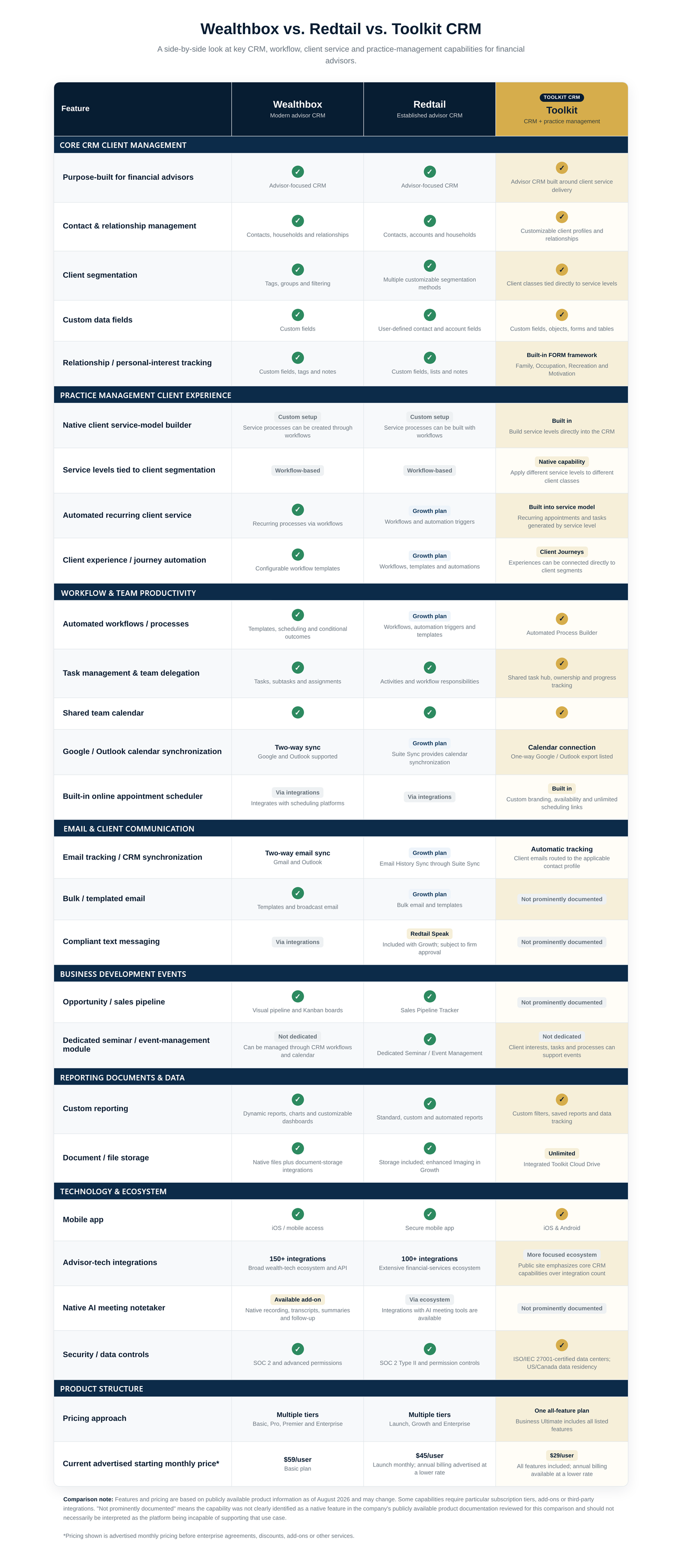
Quick Financial Advisor CRM comparison:
Workflows and Practice Management
Workflow functionality has become the basic table stakes for a modern CRM. The difference is whether your CRM merely allows you to create workflows or helps determine which workflows your business should have in the first place.
Wealthbox CRM

Wealthbox provides customizable automated workflows that can be created as sequential processes or checklists. Workflows can include scheduling, templates, collaboration, subtasks, milestones and conditional outcomes depending on the plan selected.
That flexibility makes Wealthbox attractive to firms that already know what their processes should look like and want a relatively intuitive system for putting those processes into action.
Redtail CRM

Redtail also places considerable emphasis on workflow automation. Its Growth plan includes process workflows, automation triggers and templates, giving advisory teams the ability to build repeatable processes around onboarding, reviews, administration and other recurring activities.
Redtail's maturity is an advantage here. Firms can build a substantial operating infrastructure around the platform.
Toolkit CRM

Toolkit also enables firms to build and automate their own step-by-step processes. These processes can include appointments, tasks, follow-up activities and specific responsibilities assigned to individual team members, helping ensure everyone knows what needs to happen, when it needs to happen and who is responsible.
Processes can also be dynamic. If the timing of one step changes, for example, an appointment moves by two days, the subsequent activities within the sequce can automatically move by the same amount. This helps keep the entire process aligned without requiring the team to manually reschedule every related task or activity.
This combination allows firms to create consistent and repeatable processes for activities such as client onboarding, review meetings, prospecting, service activities and other recurring workflows.
Client Service and Relationship Management
Every CRM stores client information. The question is whether that information helps create a more consistent and personalized client experience or is merely filed away.
Redtail provides contact and account management, notes, activities, calendaring, segmentation and automated workflows that can be used to coordinate client service across a team.
Wealthbox similarly centralizes contacts, households, tasks, notes, emails, files and other relationship data. Its activity-stream approach can be particularly useful for collaboration because team members can quickly see recent activity surrounding a client relationship.
Toolkit also centralizes contacts, households, tasks, notes, emails, files and other important relationship data, providing the core CRM functionality needed to manage and coordinate client relationships across a team.
The key differentiator is Toolkit's emphasis on an automated service model.
Rather than relying on team members to remember when and how each client should be contacted, Toolkit can establish a predetermined service cadence based on the importance and needs of the relationship. Activities, appointments, tasks and responsibilities can be automatically scheduled and assigned to the appropriate team members, helping ensure the intended client experience is delivered consistently.
This reflects an important practice-management principle: reactive client service is not the same thing as a client experience.
A client should not receive attention simply because someone remembered to call them. The CRM should help ensure that the right activities happen at the right time, with clear responsibility across the team.
For firms trying to move from an advisor-dependent service model toward a consistent, proactive and team-delivered client experience, this can be a significant difference.
Client Segmentation
Segmentation is another area where the three platforms should be evaluated beyond the existence of a tagging feature.
Wealthbox supports contact segmentation through tags and other organizational tools. Redtail offers customizable segmentation and multiple methods for categorizing contacts.
Both can therefore be used to divide a client base into meaningful groups.
Toolkit's approach is more closely connected to practice management.
The objective is not simply to label clients. Segmentation should ultimately influence:
- The service model a client receives
- Frequency and type of contact
- Relationship-management activities
- Opportunities for advocacy and introductions
- Allocation of team resources
- The advisor's ability to focus attention on ideal clients
That distinction can be particularly relevant for established advisors who have accumulated hundreds of client relationships over the years.
The real value of segmentation is not creating an "A Client" field in a database. It is changing what happens because a client has been classified that way.

Integrations
If integrations are the dominant consideration in your CRM decision, Redtail and Wealthbox are particularly strong competitors.
Redtail currently promotes 100+ integrations with financial-industry platforms and other technology, including connections with widely used advisor systems such as Orion, Schwab and eMoney.
Wealthbox likewise promotes 150+ technology integrations, along with API capabilities and connections to automation platforms that can extend the CRM into a broader technology stack.
For firms that have already assembled a complex ecosystem of portfolio management, planning, custodial, communications and productivity applications, integration compatibility should be mapped carefully before making any CRM change.
Toolkit's value proposition is less about winning a contest based on the sheer number of third-party applications connected to the CRM. Its differentiation is the connection between the technology and the processes, tools and intellectual capital surrounding the Pareto Systems best practices through their coaching methodology.
This makes the decision partly philosophical.
If your goal is to assemble a technology stack from a large number of specialized applications, integration breadth may carry considerable weight.
If your goal is to create a more unified practice-management environment around a defined operating methodology, Toolkit deserves a different kind of consideration.
Usability and Team Adoption
A CRM that nobody consistently uses is not a CRM, it is an expensive database.
Fortunately, usability is a strength across all three platforms. Wealthbox, Redtail and Toolkit are all designed specifically for financial professionals and aim to make day-to-day CRM activity intuitive and accessible for both advisors and team members.
Wealthbox has built a strong reputation around simplicity and a modern user experience. Its interface and activity-stream model are designed to make CRM activity feel familiar and collaborative, helping teams quickly see and manage client activity.
Redtail also places a strong emphasis on usability, onboarding, support and training. Its long-standing presence in the advisor marketplace can also be an advantage, as many financial professionals and support staff already have experience using the platform.
Toolkit CRM was similarly designed to be modern, intuitive and easy to use. Its interface is built to help advisors and team members quickly access client information, manage daily activities and follow established processes without unnecessary complexity.
Where Toolkit differentiates itself is not by sacrificing usability for functionality, but by combining an easy-to-use CRM experience with the practice-management processes, automation and service models built into the platform.
Ultimately, all three provide approachable CRM experiences for financial advisory firms. The more important consideration is which platform best aligns with how the firm wants its team to work and how consistently it wants its processes to be executed.
Pricing
Price should be considered in context rather than isolation.
As of August 2026, Wealthbox lists its plans at:
- Basic: $59 per user/month
- Pro: $75 per user/month
- Premier: $99 per user/month
- Enterprise: custom pricing
Redtail currently lists:
- Launch: $39 per user/month when billed annually, or $45 monthly
- Growth: $59 per user/month when billed annually, or $65 monthly
- Enterprise: custom pricing
Toolkit CRM lists at:
- $29 USD per user/month
- Annual plan includes a 10% discount
- No long-term contracts
The features available at each tier differ, so headline subscription prices are not necessarily apples-to-apples comparisons.
More importantly, the cost of a CRM for financial advisors should not be evaluated only as a software expense.
Consider the value of:
CRM + workflow tools + training + implementation + practice-management resources + outside applications required to fill functionality gaps.
Support and Implementation
CRM implementation is where many otherwise good technology decisions begin to fail.
Migrating data is only part of the challenge. The larger issue is getting everyone to use the new system consistently.
Wealthbox promotes CRM migration assistance, a help desk, live help, tutorials and a knowledge base, with additional implementation resources available for enterprise customers. It also emphasizes migration support for firms switching from another CRM.
Redtail offers dedicated onboarding, support and training resources and complimentary data importing, backed by a company with a significant installed base in the financial-advisor market.
Toolkit CRM assists with data migration from their current provider (at no additional cost), CRM customizations, team training, and assigning a dedicated implementation team. The implementation team works with firms to understand their existing processes and customize best-practice workflows to suit their specific needs. The Support Team is readily available for questions and training both via email and phone.
For an advisory firm, that raises an important buying question:
Are you looking for help implementing software, or help implementing a better business process through software?
Those are not necessarily the same thing.

Which CRM Is Best for a Solo Advisor, Small Team or Growing RIA?
The answer depends heavily on the maturity and objectives of the practice.
Solo Advisor
A solo advisor who wants simplicity, strong core CRM capabilities and quick adoption may find Wealthbox particularly appealing.
Redtail can also be attractive for solo advisors who want an established advisor-specific ecosystem and broad integrations.
Toolkit becomes especially compelling for the solo advisor who wants to build repeatable processes before adding staff. Standardizing the business early can make future delegation and scalability much easier.
Small Advisory Team
For a small team, collaboration and workflow consistency become more important.
Wealthbox's intuitive interface and collaborative activity stream are strengths here. Redtail's workflow capabilities and established integration network can also make it a strong option.
Toolkit deserves particular consideration when the objective is not simply coordinating the team but ensuring that everyone follows a defined service and relationship-management process.
Growing RIA
A growing RIA needs to think about scalability.
Redtail's integrations, workflow capabilities and enterprise presence make it a logical contender. Wealthbox offers increasingly sophisticated workflow, reporting, workspace and enterprise capabilities while maintaining its emphasis on usability.
Toolkit may appeal most strongly to RIAs that see growth as a process challenge rather than merely a technology challenge.
As additional advisors and staff are added, tribal knowledge becomes increasingly dangerous. What one advisor "just knows" about serving a client has to become a documented, transferable process.
That is where process-driven CRM becomes particularly valuable.
Process-Driven Advisory Firm
This is where Toolkit arguably makes its strongest case.
If a firm's objective is to systematize client segmentation, relationship management, service delivery, referrals, team activity and other practice-management disciplines, Toolkit's connection to Pareto's methodology becomes a meaningful differentiator.
Instead of adapting a general CRM framework to the firm's practice-management philosophy, the two are designed to work together.
What Should You Consider Before Switching from Your Current CRM?
Changing CRMs is a major operational decision. Avoid switching because another platform has a more attractive interface or one appealing feature.
Before moving, examine at least five areas.
First, audit your data. Determine which contacts, notes, activities, custom fields, documents and historical records need to migrate.
Second, map your integrations. Identify every system connected to your existing CRM and determine how each would operate after the transition.
Third, document your workflows. A CRM migration is an excellent opportunity to eliminate outdated procedures instead of automatically recreating them in a new system.
Fourth, examine team adoption. The theoretically superior CRM can become the inferior choice if the team will not use it consistently.
Fifth, define the business problem you are trying to solve.
This last question is especially important.
If Toolkit, Redtail or Wealthbox already handles your contact management adequately, switching another CRM simply to obtain another contact database would make little sense. The more compelling reason to consider another CRM is to play a larger role in systematizing how the practice is managed and how clients are served.
Toolkit CRM vs. Wealthbox CRM vs. Redtail CRM: The Bottom Line

So, which is the best CRM for financial advisors?
The reality is that Wealthbox, Redtail and Toolkit are all strong options. The right choice comes down to what you want your CRM to do for your business.
If your priority is a clean, modern interface with strong collaboration and easy adoption, Wealthbox is well worth considering.
If you want an established advisor CRM with extensive integrations, customizable workflows and a large industry footprint, Redtail remains a strong choice.
If you want a modern, easy-to-use CRM that also helps institutionalize practice-management processes, automate your service model, create consistency across the team and connect daily activity with proven advisory best practices, Toolkit offers a differentiated approach.
Ultimately, a financial advisor CRM comparison should go beyond a checklist of features. The better question is:
How do you want your CRM to help your business operate?
Do you want flexibility to build your own workflows and processes?
Do you want a familiar platform with a broad ecosystem and long industry track record?
Or do you want a CRM that combines core relationship management with built-in practice-management methodology and automation?
The best way to answer that question is simple: try them all.
Take advantage of demos or trial periods, involve the people on your team who will use the CRM, and test each platform against the real activities your practice manages every day.
The best CRM for your firm will be the one your team finds easy to use, supports the way you want to serve clients, and helps your business operate more consistently as it grows.